All over the world, a third participant in the dialogue between doctor and patient has appeared in hospital rooms. And this is not a family member, or a lawyer, but generative artificial intelligence - ChatGPT, Claude, Gemini. Almost everyone has their favorite chatbot, from which you can not only request the necessary information and have a heart-to-heart conversation, but also discuss test results and “break through” the symptoms of the onset of illness. Kazakhstan does not remain aloof from this trend. The patient can come to the appointment not only with test results and their own guesses, but also with a ready-made interpretation of the chatbot. In an opinion column for Tengri Health, resident surgeon Botagoz Kaukenova discusses why patients are increasingly turning to AI for medical advice and how a “doctor” who is always at hand is already changing medicine. Millions of people are already discussing their health with AI. Almost everyone and almost everywhere is discussing their health with artificial intelligence. It is already difficult to call this phenomenon limited by geography or some part of the demographic layer. AI chat is available to anyone with internet access. In June 2026, the Pew Research Center (an American independent research center) surveyed 3,488 American adults: 34 percent of them admitted that they had used a chatbot at least once for one of the following medical tasks: 25 percent tried to understand the cause of symptoms, 20 percent analyzed test results, 15 percent decided using AI whether to go to the doctor at all. OpenAI reports that more than 230 million people asked health questions per week in June 2026, and more than 300 million in July. Independent sources show a similar picture. The authors of the Nature Health publication analyzed 1.7 million anonymized health conversations with Microsoft Copilot in 109 countries. They found a link between low public trust in hospitals and a higher proportion of chatbot calls for health issues. At the same time, the authors emphasize that the study reveals correlations at the country level, and does not prove a cause-and-effect relationship. Many doctors have a completely understandable, perhaps even irritated, reaction at this point: the AI makes mistakes, does not see the patient, and cannot be trusted with diagnosis and treatment. It's true, yes. The problem is that the phrase "don't use ChatGPT" is almost useless as a strategy for communicating with patients. First, people asked neighbors who had similar experiences for advice, then they sat on forums, and later they Googled symptoms. That is, the desire to get medical advice from someone other than a doctor clearly did not arise with the spread of ChatGPT. Therefore, another question is much more interesting: why exactly did AI turn out to be such an attractive competitor? Botagoz Kaukenova Surgeon, resident Why a chatbot has become a doctor's competitor The answer partly lies in the KFF survey data among Americans who used AI to obtain information or advice about health. Background: KFF is an independent American nonprofit organization that researches health care and medical policy issues, conducts public opinion polls, and produces health journalism. According to the study's authors: 65 percent cited the ability to get information right away as one of the main reasons, 41 percent wanted to understand the problem before deciding whether to see a doctor, 36 percent felt more comfortable asking sensitive questions in confidence, 19 percent could not afford to see a doctor financially, 18 percent because they did not have “their” doctor or could not make an appointment. These reasons are quite understandable to the Kazakh patient. The opportunity to get an answer immediately is especially attractive when a person does not know which specialist to contact, or understands that finding a doctor is not so easy and will have to wait. But please note: none of the listed reasons sounds like “I think AI is smarter than a doctor.” It’s just that you can ask AI at one in the morning, it doesn’t get annoyed, it remembers what you said five months ago, and can answer 20 clarifying questions with the same willingness and enthusiasm as it answered the first one. But the key property of AI is still the synthesis of information. When a person Googled symptoms, the search engine returned a dozen links: a hospital website, a doctor’s blog, an advertisement for dietary supplements, an obscurantist forum. Before, we could read all this on our own and, having critically assessed the information (ideally), draw conclusions and make a decision. But now it seems that it is difficult and too long - why waste energy and time if there is a round-the-clock assistant - AI? It is enough to formulate a request and he will answer. Previously, a person who himself read different sources saw possible contradictions in the information and perceived them as a signal - everything here is ambiguous, it is necessary to check further (again, ideally). Generative AI, if it is not clearly configured first (and not everyone knows how to do this), takes all the same, possibly contradictory sources and collects from them one smooth, and even personalized answer, which is difficult to suspect of inaccuracies. And this is where the strength of generative AI simultaneously becomes its weakness. A person receives not a set of information that he has yet to evaluate, but a ready-made interpretation of his own situation. And there is a thin line between trying to make sense of information and helping make a medical decision. “Explain the diagnosis” and “give me a diagnosis”: why it is important to separate these concepts The phrases “explain to me the diagnosis” and “give me a diagnosis” sound similar, but in fact there is a gap between them. From a medical point of view, these are completely different tasks and the AI model performs them with different quality. In February 2026, researchers from the Icahn School of Medicine at Mount Sinai developed 60 clinical scenarios from 21 medical fields. Each scenario was run through ChatGPT Health under 16 different conditions for a total of 960 queries. The system's recommendations were compared with the consensus assessment of three independent physicians who relied on clinical guidelines. What happened in the end? The system correctly recognized stroke and anaphylaxis, but, for example, diabetic ketoacidosis and increasing respiratory failure sent me to see a doctor in the next “day or two,” although this should have been done immediately. Overall, ChatGPT Health underestimated the urgency of 52 percent of simulated emergencies. Yes, AI can cope well in some situations and make mistakes in others - everyone already understands and accepts this. But even one misdiagnosis of AI where lives may be at stake is too high a price to pay for underestimating the risk. AI knows about a person what he told about himself What is another unobvious problem? You decide what to tell the AI. The doctor looks at you, assesses your condition, asks questions, puts together a picture and can change the initial hypothesis on the fly. You yourself, when talking to AI, may not know what is important to communicate - and end up receiving an answer with incomplete data. Moreover, the artificial intelligence model adapts to the request that was originally received. The researchers also tested whether another person's opinion influenced the model's recommendations. When a relative or friend was added to the scenario and downplayed the severity of symptoms, borderline cases were almost 12 times more likely to change the urgency recommendation! However, in most cases, the AI advised seeking help less urgently. If you open a chatbot at one in the morning, you most likely already have some kind of hypothesis in your head about what is currently happening to you. You can convince yourself that “it’s nothing to worry about,” “it’s a side effect,” “it’ll go away soon.” You don't start chatting and receiving answers as a neutral observer - you already set a certain frame. If the wording of the question itself can shift the model’s answer, then personalization ceases to be an advantage. Errors that remain invisible And one more very important point: yes, AI and doctors make mistakes. I won't compare frequencies because the errors are not equivalent - they simply cannot be compared. But when a doctor makes a mistake, there remains an entry in the medical history, the name of the doctor, his recommendations, and actions. Of course, incorrect treatment will not always be noticed, and it will not necessarily be sorted out. But it’s still better than impersonal recommendations from an AI that you can’t ask. I am not trying to idealize our medicine and I see its problems very well. An examination by a doctor does not guarantee either a high-quality medical history, a correct diagnosis, or correct treatment. Sometimes a patient has to go from doctor to doctor precisely because the system did not work. And this is one of the reasons why AI is so attractive. But the important difference is that medicine at least has a potential mechanism for re-testing the decision. Personal correspondence with a chatbot is most often not included in this circuit at all. But still, the doctor’s mistake exists in the material world. When the AI makes a mistake, it remains outside the system. No one may know about this, especially the patient himself. Because no one will go into last November’s chat to check whether the AI gave the correct answer when it was first asked about the diagnosis. Although chatbots are good at admitting their mistakes and apologizing for them. For Kazakh medicine, which is actively implementing AI technologies, this is no longer an abstract discussion about the future. Artificial intelligence is already influencing the communication between doctor and patient - and now it is important to understand how to take this into account in your work. What should change in the communication between doctors and patients in Kazakhstan I believe that the new task of the doctor is not to convince the patient never to ask the AI, it is to make this conversation visible. Ask at the reception: "What have you already searched for? What did the chatbot answer you?" “What decisions did you make based on this?” They are not needed to catch a person making a mistake. They help to understand with what ideas, fears and expectations he came to the appointment. Sometimes the patient has already diagnosed himself, refused the prescribed drug, or, conversely, convinced himself that dangerous symptoms do not require attention. If we don't ask, we won't find out. We can repeat as much as we like that ChatGPT is not a doctor. But if the patient, after the consultation, did not understand the diagnosis, did not understand the logic of treatment and does not know when to contact again, he will still receive an explanation in another place, be it Google or AI. The doctor does not need to judge the patient. Trust rarely comes just because you are a doctor. It is formed when a person is given the opportunity to ask a “stupid” question, a difficult question is explained in an understandable language, and together they discuss further actions. Because if the doctor was unable to clearly convey the information, and also got into an argument with the person who came to him for help, the patient will go elsewhere for an explanation. And it will be good if you go to another doctor. But, most likely, the patient will simply continue to correspond with someone who understands him perfectly and answers questions silently, calmly and without reproach. Perhaps the biggest question for medicine right now really isn't why patients trust AI. And the fact is that it is they who receive from him what they did not receive from us. Time, attention, clear language, a sense of security or the right to ask questions without fear of seeming awkward or stupid? The opinion of the author may not coincide with the opinion of the editors About the expert: Botagoz Kaukenova is a surgeon, resident, expert in communication and health literacy with a fundamental biomedical education. Head of the public fund MedSupportKZ, which implements projects in partnership with WHO, UNICEF, UNFPA. Engaged in clinical work, research activities, teaching, public speaking and popular science activities in the field of evidence-based medicine and public health.
From the original source:
Tengrinews — AI (Google News)
Read full article at Tengrinews — AI (Google News)This material was compiled from public sources. If its publication affects your rights → Request removal
Он не раздражается и отвечает в час ночи“: почему пациенты выбирают ChatGPT
Он не раздражается и отвечает в час ночи“: почему пациенты выбирают ChatGPT.
AI Summary & Key Takeaways
- Он не раздражается и отвечает в час ночи“: почему пациенты выбирают ChatGPT.

Related stories
You ask the AI to make an animation for the intro to the video. I already have an idea in my head of what it should look like...
You ask the AI to make an animation for the intro to the video. You already have an idea in your head of how it should look, but you don’t know what the desired effect is called. All that remains is to write something like “make it cooler and more impressive,” and the result depends on luck. motion-prompt was created exactly...
Chroma Awards has opened applications for the second season of the competition
🎬 Chroma Awards has opened applications for the second season of the competition The organizers announced the return of the Chroma Awards, a competition for authors working with AI and digital creativity. This season, participants can expect: • More than $450,000 in cash prizes and travel bonuses. • $1 million in...
RUШесть топовых ИИ-моделей попытались спасти яйцо от падения — победила Claude
🥚 Шесть топовых ИИ-моделей попытались спасти яйцо от падения — победила Claude Нейросетям дали одинаковое задание: спроектировать защитную капсулу для сырого яйца, которую затем изготовят на 3D-принтере. Условия были строгими: не более 250 г пластика, 8 часов печати и 20 ватных…
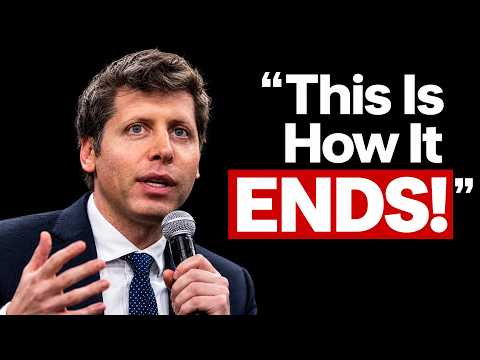
Sam Altman Reveals OpenAI's FINAL PLAN (It's Insane)
Sam Alman, the CEO of OpenAI, the company behind ChatGpt, just told his own employees that there are only three ways this whole AI race can end. And one of those endings is a single company getting so powerful that it can literally melt everyone else's GPUs. This is not a…